
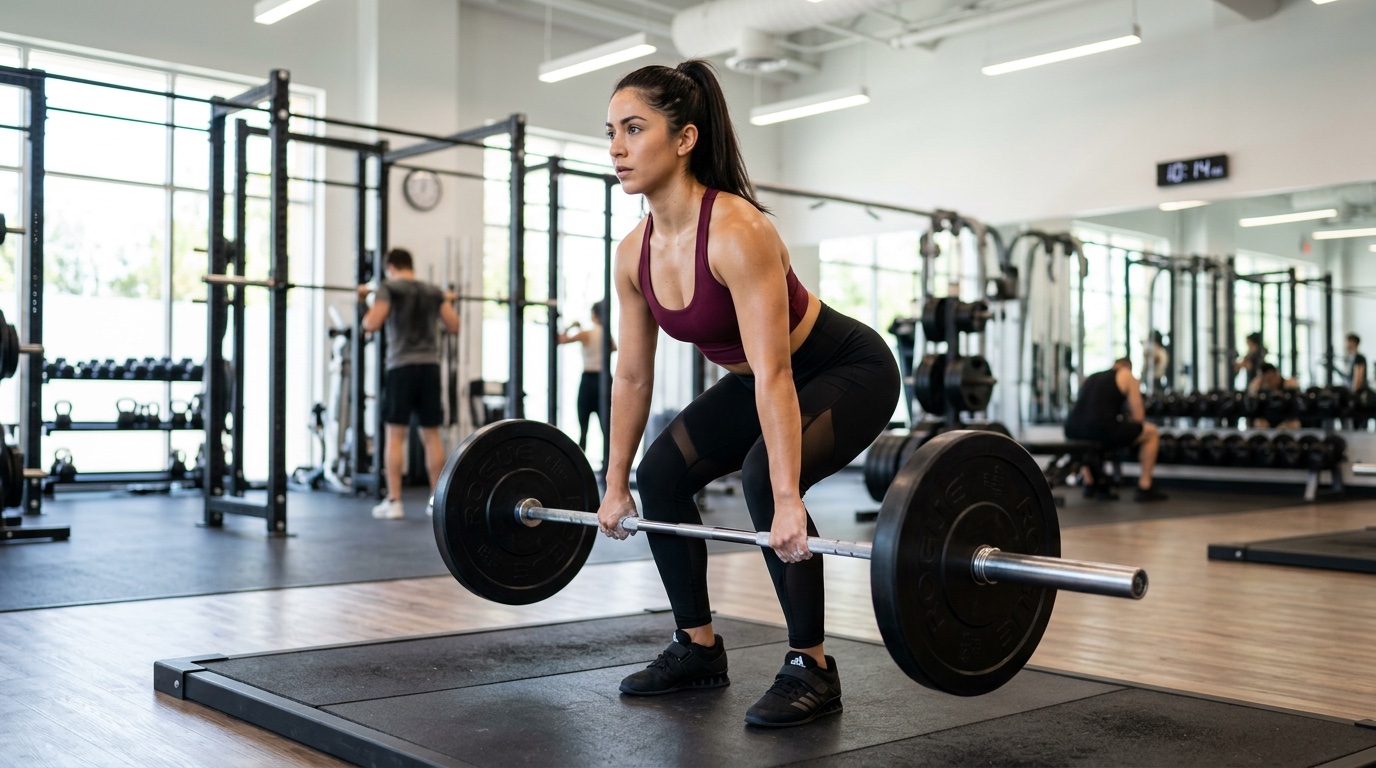
Walking into a weight room for the first time feels like showing up to a party where everyone knows each other and you don't know anyone's name. The equipment looks intimidating, the people seem to know exactly what they're doing, and you have no idea where to start.
Here's the truth nobody in that weight room will tell you: every single one of them felt the same way on their first day. And most of them are far too focused on their own workout to notice yours.
This guide will take you from "I don't know what I'm doing" to confidently walking into any gym and executing a real, effective strength training program. No fluff, no bro-science, just the fundamentals that actually matter.
Why Strength Training Matters (For Everyone)
Strength training isn't just for bodybuilders or athletes. It's arguably the single most important form of exercise for long-term health, and the science on this is overwhelming. Major guidelines treat muscle-strengthening as a core part of adult health. The CDC's overview of physical activity benefits for adults covers bone strength, balance, and chronic-disease risk in plain language.
Muscle is a longevity organ. After age 30, you lose 3-8% of muscle mass per decade without resistance training. This accelerates after 60. The medical term is sarcopenia, and it's directly linked to falls, fractures, metabolic disease, and loss of independence in older adults. Strength training is the only reliable way to prevent it.
It transforms your metabolism. Muscle tissue is metabolically active — it burns calories at rest. Adding even a few pounds of muscle meaningfully increases your resting metabolic rate, making it easier to maintain a healthy body composition long term.
It strengthens your bones. Resistance training increases bone mineral density, reducing osteoporosis risk. This is especially critical for women, who face dramatically higher osteoporosis rates after menopause.
It improves everything else. Blood sugar regulation, cardiovascular markers, joint health, mental health, sleep quality, posture, confidence — the downstream effects of strength training touch nearly every aspect of physical and psychological well-being.
You don't need to become a powerlifter. You just need to consistently challenge your muscles against resistance, progressively increasing that challenge over time. That's it.
The Five Fundamental Movement Patterns
Every effective strength training program is built around five basic human movement patterns. Learn these, and you'll understand the logic behind any well-designed program.
1. Squat (Knee-Dominant Lower Body)
The squat pattern involves bending at the knees and hips to lower your body, then standing back up. It primarily trains your quadriceps, glutes, and core.
Beginner exercise: Goblet Squat
Hold a dumbbell vertically at your chest with both hands. Stand with feet shoulder-width apart, toes pointed slightly outward. Push your hips back and bend your knees to lower yourself until your thighs are at least parallel to the floor. Drive through your full foot to stand back up.
Form cues:
- Keep your chest up and proud — the dumbbell at your chest helps with this
- Push your knees out over your toes, don't let them cave inward
- Your weight should be distributed across your whole foot, not just your toes
- Go as deep as your mobility allows while keeping your lower back neutral
2. Hinge (Hip-Dominant Lower Body)
The hinge pattern involves bending primarily at the hips with minimal knee bend. It trains your posterior chain — glutes, hamstrings, and lower back.
Beginner exercise: Romanian Deadlift (Dumbbell)
Hold a dumbbell in each hand in front of your thighs. With a slight bend in your knees (that stays constant), push your hips straight back like you're closing a car door with your butt. Lower the dumbbells along your legs until you feel a strong stretch in your hamstrings. Squeeze your glutes to return to standing.
Form cues:
- Your back stays flat — imagine a broomstick along your spine
- The movement comes from your hips, not your lower back
- Keep the dumbbells close to your body throughout
- You should feel this in your hamstrings and glutes, not your lower back
3. Push (Upper Body Push)
Pushing movements involve extending your arms away from your body against resistance. They train your chest, shoulders, and triceps.
Beginner exercises: Dumbbell Bench Press and Overhead Press
Dumbbell Bench Press: Lie on a bench with a dumbbell in each hand at chest level. Press the dumbbells up until your arms are extended, then lower them back to chest level with control.
Form cues:
- Keep your shoulder blades pinched together and pressed into the bench
- Lower the dumbbells to the sides of your chest, not your neck
- Your wrists should be stacked over your elbows at the bottom
- Feet flat on the floor, slight arch in your lower back is fine
Overhead Press: Stand with dumbbells at shoulder height. Press them straight overhead until your arms are fully extended. Lower back to shoulders with control.
Form cues:
- Brace your core like someone's about to poke your stomach
- Don't lean back excessively — if you have to arch your back dramatically, the weight is too heavy
- Fully lock out at the top, pushing your head slightly forward between your arms
4. Pull (Upper Body Pull)
Pulling movements involve pulling resistance toward your body. They train your back, biceps, and rear shoulders.
Beginner exercises: Dumbbell Row and Lat Pulldown
Dumbbell Row: Place one hand and knee on a bench for support, other foot on the floor. Hold a dumbbell in the free hand hanging straight down. Pull the dumbbell to your hip, squeezing your shoulder blade back. Lower with control.
Form cues:
- Pull to your hip, not your shoulder — think "elbow to ceiling"
- Keep your torso parallel to the floor, don't rotate
- Control the lowering portion; don't let the dumbbell just drop
- Your back should stay flat throughout
Lat Pulldown: Sit at the pulldown machine with your thighs secured under the pads. Grip the bar slightly wider than shoulder width. Pull the bar to your upper chest, leading with your elbows. Return to the top with control.
Form cues:
- Lean back slightly (about 15-20 degrees), but don't swing
- Pull to your upper chest, not behind your neck
- Imagine pulling your elbows into your back pockets
- Full stretch at the top — let your arms extend completely
5. Carry (Core and Total Body Stability)
Carries involve holding weight while walking. They train your grip, core, shoulders, and overall stability in a uniquely functional way.
Beginner exercise: Farmer's Walk
Pick up a heavy dumbbell in each hand. Stand tall, shoulders back and down. Walk with controlled, even steps for a set distance or time.
Form cues:
- Stand as tall as possible — pretend you're trying to be an inch taller
- Don't let the weights pull your shoulders forward or down
- Take normal strides, don't shuffle
- Breathe normally; don't hold your breath
How to Pick Your Starting Weights
This is where most beginners either go too heavy (ego) or too light (fear). Here's a practical method:
The "three reps in reserve" test. For your first session with any exercise, start with a weight you think might be too light. Do a set of 10 reps. If you could have done 13+ reps, it's too light. Go up. If you could have done exactly 12-13, you're in the right zone — you had about 2-3 reps left in the tank.
For your first few weeks, every set should end with you feeling like you could have done 2-3 more reps. This leaves enough room to learn proper form without injury risk while still being challenging enough to drive adaptation.
Don't worry about the absolute numbers. Nobody in the gym cares that you're pressing 15-pound dumbbells. Seriously. Everyone started somewhere, and the person pressing 80s remembers when they couldn't press 20s. The only number that matters is whether it's more than last week.
Your 3-Day Beginner Program
This program uses a full-body approach, training three days per week with at least one rest day between sessions (Monday/Wednesday/Friday works well). Each session trains all five movement patterns.
Day A
| Exercise | Sets x Reps | Rest |
|---|---|---|
| Goblet Squat | 3 x 10 | 90 sec |
| Dumbbell Bench Press | 3 x 10 | 90 sec |
| Dumbbell Row (each side) | 3 x 10 | 90 sec |
| Romanian Deadlift | 3 x 10 | 90 sec |
| Farmer's Walk | 3 x 40 sec | 60 sec |
Day B
| Exercise | Sets x Reps | Rest |
|---|---|---|
| Leg Press | 3 x 12 | 90 sec |
| Overhead Press | 3 x 10 | 90 sec |
| Lat Pulldown | 3 x 10 | 90 sec |
| Hip Thrust | 3 x 12 | 90 sec |
| Plank | 3 x 30-45 sec | 60 sec |
Day C
| Exercise | Sets x Reps | Rest |
|---|---|---|
| Goblet Squat | 3 x 10 | 90 sec |
| Incline Dumbbell Press | 3 x 10 | 90 sec |
| Cable Row | 3 x 12 | 90 sec |
| Romanian Deadlift | 3 x 10 | 90 sec |
| Farmer's Walk | 3 x 40 sec | 60 sec |
Alternate between weeks: Week 1 runs A-B-C, Week 2 runs B-C-A, and so on. This ensures balanced exposure to all exercises.
Progression Protocol
Each session, try to add one rep to each exercise until you can complete all sets at the top of the rep range. Once you hit 3x12 for an exercise, increase the weight by the smallest increment available (usually 5 lbs for dumbbells) and drop back to 3x8. Build back up to 3x12. Repeat.
This simple linear progression will drive consistent gains for months. Write down every workout — what weight you used, how many reps you got on each set. If you don't track it, you can't progress it.
Nour has beginner-specific programs with video demonstrations for every single exercise, which makes those first weeks dramatically less stressful when you're not sure if your form is right. Having a video reference at your fingertips in the gym removes the guesswork.
Gym Etiquette Basics
Knowing these unwritten rules removes social anxiety fast:
Re-rack your weights. Always. Every time. Put dumbbells back in their spots, unload barbells when you're done, return plates to the tree. This is the single most important gym etiquette rule.
Wipe down equipment after use. Most gyms provide spray bottles and paper towels or wipes. Use them on benches, pads, and handles after you finish.
Don't stand directly in front of the dumbbell rack. Grab your dumbbells and step back. People need access to the rack while you're working.
Don't hog equipment during peak hours. If the gym is busy, limit rest times on machines and don't superset across three different stations. Be willing to let people work in between your sets.
It's fine to ask. "How many sets do you have left?" and "Mind if I work in?" are perfectly normal gym interactions. Most people are happy to share.
Leave your phone calls outside. Texting between sets is fine. Having a speakerphone conversation while sitting on the only bench press is not.
Headphones mean "don't talk to me." Respect this signal from others, and use it yourself when needed.
Safety and Injury Prevention
Warm up before lifting. Five to ten minutes of light cardio (walking, cycling) followed by dynamic stretches and warm-up sets with lighter weight. Cold muscles are injury-prone muscles.
Learn form before chasing weight. The first two weeks should be entirely about nailing movement patterns with conservative weight. Bad form under heavy load is the primary cause of gym injuries.
Never sacrifice form for more reps. When your form breaks down, the set is over. That last ugly rep isn't worth the risk.
If something hurts (not to be confused with muscle fatigue), stop. Sharp pain, joint pain, or anything that feels "wrong" is your body's error message. Continuing through it leads to actual injury. Muscle burn and fatigue during a hard set are normal and expected. Pain in a joint or a sudden sharp sensation is not.
Use safety equipment. Squat rack safety pins should be set just below your lowest squat position. If you're bench pressing alone, use a power rack with safeties or dumbbells instead of a barbell. Never bench press heavy weight alone without a spotter or safety mechanism.
Rest days are training days. Muscles grow during recovery, not during the workout itself. Skipping rest days doesn't make you dedicated; it makes you overtrained. Three to four training days per week is plenty for beginners.
The Most Common Beginner Mistakes
Doing too much, too soon. You don't need a 6-day program with 25 sets per muscle group. Three full-body sessions per week with moderate volume is optimal for beginners. More isn't better — more than you can recover from is worse.
Copying advanced lifters' routines. That bodybuilder's split routine was designed for someone with years of training adaptations and (often) pharmacological support. Beginners respond best to full-body training with basic movements.
Skipping legs. The internet joke exists because it's real. Training your legs isn't optional. Your lower body contains the largest muscles in your body, and training them drives hormonal responses that benefit your entire physique.
Majoring in the minors. Spending 40 minutes on bicep curls and lateral raises while skipping squats and rows is backwards. Compound movements first, isolation work second.
Not eating enough protein. Training is the stimulus; protein is the raw material for muscle building. Aim for 0.7-1g per pound of body weight daily. Most beginners dramatically undereat protein.
Expecting immediate results. Real, visible changes take 8-12 weeks of consistent training. Strength gains come faster — you'll notice weights feeling easier within 2-3 weeks — but visual changes require patience.
How to Know When You're No Longer a Beginner
The beginner phase isn't about time served. It's about how quickly you can recover and progress. You're no longer a beginner when:
- You can no longer add weight every session. Linear progression stalls and you need more sophisticated programming (periodization, deloads, varied rep ranges).
- You can perform all basic movement patterns with solid form under moderate to heavy load without thinking about each cue.
- You have a baseline of strength. Rough benchmarks for men: bodyweight squat, 0.75x bodyweight bench, 1.25x bodyweight deadlift. For women: 0.75x bodyweight squat, 0.5x bodyweight bench, 1x bodyweight deadlift. These aren't universal, just ballpark indicators.
- You understand your body's response to training. You know which exercises you feel most, how long you need to recover, and when you're actually pushing hard versus going through the motions.
For most people, this transition happens somewhere between 6-12 months of consistent training. Once you're there, intermediate programming with more nuanced periodization becomes necessary.
Getting Started This Week
The biggest barrier to starting isn't knowledge — it's action. You now have everything you need to walk into a gym and execute an effective program. Here's your checklist:
- Pick three days this week for your workouts. Block them in your calendar.
- Do Day A on your first session. Start with light weights. Focus on form.
- Write down what you did. Every exercise, weight, sets, and reps.
- Eat protein at every meal. Aim for at least 0.7g per pound of body weight daily.
- Show up for Day B even if you're sore from Day A. Mild soreness is normal and actually improves with movement.
The best program is the one you'll actually follow. Start simple, stay consistent, and trust the process.
Get a structured beginner program with video demos, built-in progression tracking, and guided coaching — designed for your first weeks of lifting.
Start Training with Nour