
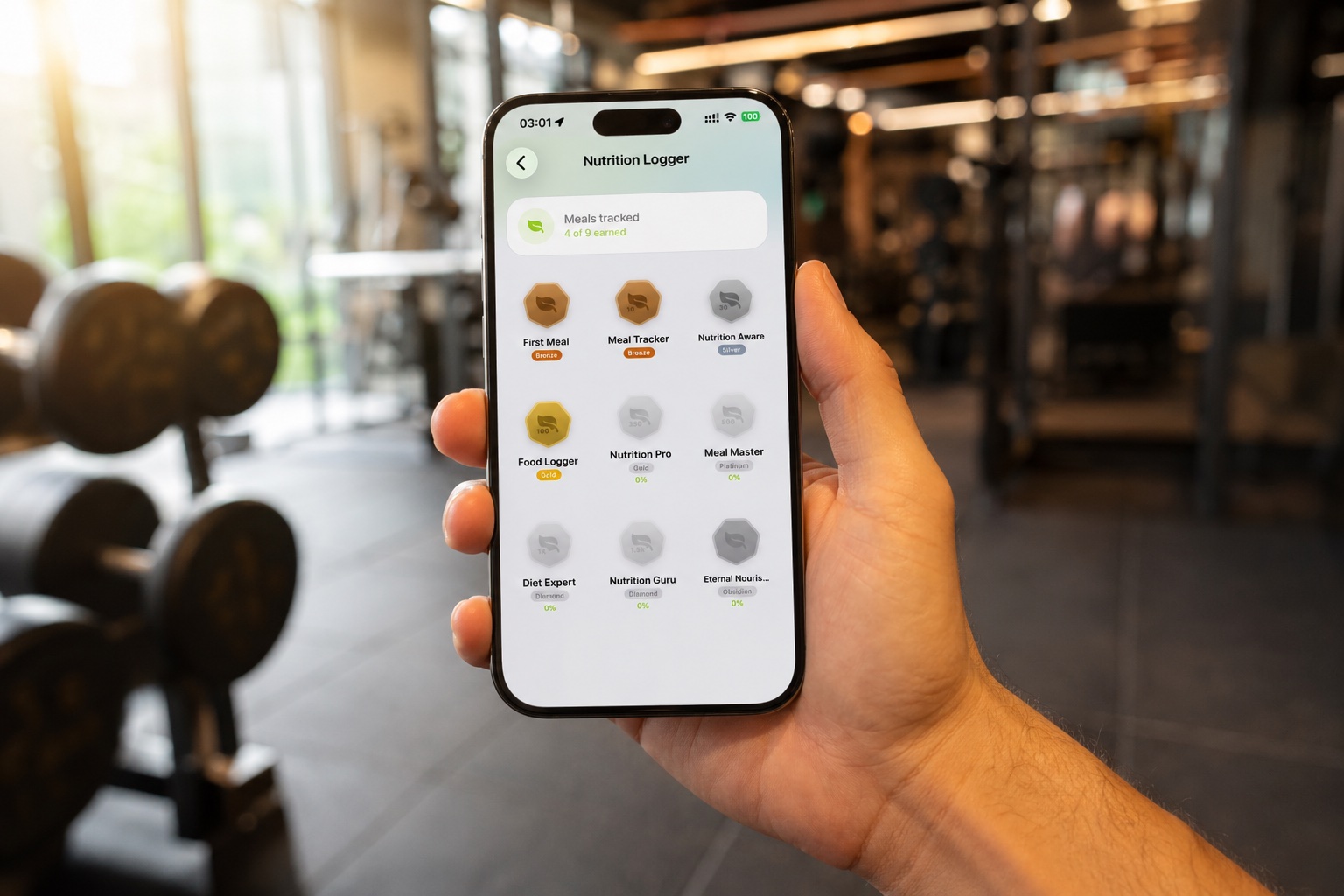
When fitness apps started adding badges and achievements, the reaction from serious fitness circles was predictable: "This isn't a video game." "Just train hard and stop needing a gold star." "Real motivation comes from within."
They're right about one thing — fitness isn't a game. But they're wrong about badges being trivial. The psychology behind achievement systems, progress markers, and gamification mechanics is grounded in decades of behavioral science research, and the data shows that well-designed gamification genuinely changes behavior in ways that willpower alone cannot.
The question isn't whether gamification works in fitness. It does. The question is why it works, when it backfires, and how to design systems that serve real fitness goals instead of just boosting app engagement metrics. (If consistency itself is your struggle, our guide on how to stay consistent at the gym covers the systems side.)
Why Your Brain Loves Achievements
The Dopamine Mechanism
Every time you earn a badge, complete a streak, or hit a milestone, your brain releases dopamine — the neurotransmitter most associated with reward-seeking behavior. But the popular understanding of dopamine is incomplete. Dopamine isn't actually the "pleasure chemical." It's the anticipation chemical.
Neuroscientist Wolfram Schultz's research showed that dopamine fires most strongly not when you receive a reward, but when you anticipate one. This is critical for understanding why achievement systems work: the badge itself isn't the primary motivator. The progression toward the badge is.
When you can see that you're three workouts away from your next streak milestone, dopamine fires every time you complete a session and move closer. The badge is the destination; the dopamine accompanies the journey.
This also explains why progression systems that show you exactly where you stand — "7 out of 10 workouts completed" — are more motivating than binary pass/fail systems. The visible progress bar itself generates the anticipation that drives behavior.
Variable Reward Schedules
B.F. Skinner's research on operant conditioning revealed something counterintuitive: intermittent, unpredictable rewards are more motivating than consistent, predictable ones. This is called a variable ratio schedule, and it's the mechanism behind slot machines, social media notifications, and the most addictive games ever designed.
In fitness gamification, variable rewards manifest as:
- Surprise badges you didn't know existed until you earned them
- Random achievements for unusual workout combinations or timing
- Milestone celebrations that appear at non-uniform intervals
- Community reactions to your posts that arrive unpredictably
The variability keeps your brain engaged because it can't predict exactly when the next reward is coming. Predictability breeds habituation; variability sustains attention.
Completion Bias
Humans have a deep psychological need to complete things they've started. This is called the Zeigarnik effect, named after psychologist Bluma Zeigarnik, who observed that people remember uncompleted tasks better than completed ones. The unfinished task nags at your brain, demanding closure.
Achievement systems exploit this beautifully. Once you've earned Bronze and Silver in a badge family, the empty Gold slot creates a cognitive itch. You're three tiers into a five-tier progression — not finishing it feels wrong. The incomplete collection drives continued effort.
This is why tiered badge systems (Bronze → Silver → Gold → Platinum → beyond) are more effective than single-level achievements. Each completed tier reveals the next one, creating a perpetual sense of productive incompletion.
Intrinsic vs. Extrinsic Motivation: A False Dichotomy
The biggest criticism of gamification in fitness comes from the intrinsic/extrinsic motivation debate. The argument goes: "Badges are extrinsic rewards. Extrinsic rewards undermine intrinsic motivation. Therefore, badges are harmful."
This is a misapplication of Edward Deci and Richard Ryan's research. Their self-determination theory does show that controlling extrinsic rewards can undermine intrinsic motivation — specifically when rewards are used to manipulate behavior and feel coercive. But their framework also identifies a spectrum of motivation, and well-designed achievement systems actually support the internalization process rather than undermining it.
How Badges Bridge Extrinsic and Intrinsic
The self-determination theory motivation spectrum runs from fully external ("I'm only doing this for the reward") through increasingly internalized forms to fully intrinsic ("I do this because I genuinely enjoy it").
In the middle sits identified regulation — where you do something because you personally value the outcome, even if it's not always enjoyable. This is where most sustainable fitness behavior lives. You don't always enjoy the workout, but you value what consistent training does for you.
Badges can facilitate this internalization process:
- Early stage (external): A beginner might train partly because earning badges feels good. This is fine as a starting mechanism.
- Middle stage (identified): As the person trains more, they begin to value the fitness outcomes that badges represent. The badge for consistency represents their identity as someone who shows up. The badge for a strength milestone represents real capability they've built.
- Later stage (integrated): The badge becomes a symbol of values the person has internalized. They'd train regardless of the badge, but the badge serves as recognition that their values are being lived out.
The key distinction: badges that recognize effort and growth support internalization. Badges that feel arbitrary or manipulative undermine it.
The Self-Determination Theory Connection
Deci and Ryan identified three basic psychological needs that drive intrinsic motivation: competence, autonomy, and relatedness. Well-designed fitness gamification can serve all three.
Competence
Competence is the need to feel effective and capable. Tiered badge progressions directly serve this need by providing clear markers of growing ability.
When you earn a strength badge that required lifting a specific total volume, you have concrete evidence of your competence. When you complete a 30-day streak, you have proof that you're capable of sustained discipline. Each badge is a data point affirming: "You are getting better at this."
Critically, the badges should track real accomplishments, not just app usage. A badge for completing 100 workouts represents genuine competence. A badge for opening the app 100 times does not. The former builds authentic self-efficacy; the latter feels hollow.
Autonomy
Autonomy is the need to feel in control of your own behavior. This is where many gamification systems fail — they prescribe a specific path and penalize deviation, which feels controlling rather than supportive.
Effective fitness gamification preserves autonomy by offering multiple paths to achievement. If badge families span different domains — activity, nutrition, consistency, strength, endurance, social engagement, variety — then every person can find achievements that align with their personal goals and training style. You're not forced to earn badges you don't care about.
The breadth of available achievements says: "However you choose to train, we recognize and celebrate your effort." That's autonomy-supportive. "You must do these specific things in this specific order to earn your rewards" is autonomy-thwarting.
Relatedness
Relatedness is the need to feel connected to others. Social badges — achievements earned through community participation, shared milestones, or collaborative challenges — satisfy this need.
When your community can see your badge progression, and when you can see theirs, a shared language of accomplishment emerges. "I just hit Obsidian tier in Consistency" means something in a community that understands the system. It creates shared context, shared celebration, and shared identity.
This is the same mechanism that makes scouting badges, military ribbons, and academic honors powerful. The achievement itself is a symbol, but the shared recognition within a community is what generates the feeling of belonging.
Gamification Mechanics That Work in Fitness
Not all gamification is created equal. Here are the specific mechanics that research and practice have shown to be most effective for fitness behavior change.
Streaks
Streaks work through loss aversion — the psychological tendency to value avoiding losses more than acquiring equivalent gains. A 45-day training streak feels like something you own, and breaking it feels like losing something valuable.
Effective streak design:
- Allow for planned rest days without breaking the streak (training 4 of 7 days can count as maintaining the streak)
- Display the streak prominently so the user sees it regularly
- Celebrate streak milestones (7 days, 30 days, 90 days, 365 days)
- Allow "streak freezes" for illness or travel — life happens, and a rigid streak that breaks during a flu is demoralizing rather than motivating
Tiered Progression
Single-level badges provide a one-time hit. Tiered systems — where each achievement has multiple levels — create ongoing motivation through the completion bias described earlier.
The most effective tier design:
- Early tiers are achievable quickly (days to weeks), providing early wins
- Middle tiers require sustained effort (weeks to months), building the habit
- Top tiers are genuinely difficult (months to year+), creating aspirational goals
- Tier names evoke progression (Bronze → Silver → Gold → Platinum → Diamond → Obsidian)
The spacing matters. If the jump from tier 3 to tier 4 requires 10x the effort of tier 2 to tier 3, people give up at the wall. Logarithmic progression — where each tier is proportionally harder but not exponentially harder — maintains engagement across the full spectrum.
Social Validation
Sharing achievements and receiving recognition from others amplifies the reward signal. A badge earned in private is satisfying. A badge earned and celebrated by your community is reinforcing.
Social validation mechanics:
- Visible badges on profiles that others can see
- Achievement notifications to your community feed
- Congratulatory reactions from community members
- Leaderboards showing who recently earned notable achievements
Collection Mechanics
Humans are natural collectors. The satisfaction of completing a set — all badges in a family, all tiers in a progression, all categories represented — taps into a deep organizational instinct.
Effective collection design shows both what you've earned and what's still available, creating a visual "map" of your fitness journey with explored and unexplored territory. The unexplored territory calls to you.
Progress Bars and Percentage Completion
Showing "67% toward your next badge" is meaningfully more motivating than showing nothing. The endowed progress effect (research by Nunes and Drèze, 2006) demonstrated that people are more likely to complete a task when they can see they've already made progress, even if that progress was given to them rather than earned.
In fitness terms: showing someone that their past three workouts have already moved them 30% toward their next milestone makes the remaining 70% feel more achievable than if they were shown a zero-start progress bar.
When Gamification Backfires
Gamification isn't universally positive. Understanding the failure modes helps you evaluate whether a system is serving you or exploiting you.
When Badges Replace the Actual Goal
If you're training specifically to earn a badge rather than to get stronger, healthier, or more capable, the gamification has hijacked the purpose of the activity. This happens when badge criteria reward behaviors that don't align with good training — like training every single day without rest, or hitting arbitrary rep counts at the expense of form.
Well-designed systems avoid this by tying badges to behaviors that are genuinely beneficial: consistency over consecutive days, progressive strength improvements, nutritional balance, recovery adherence.
When Missing an Achievement Becomes Punishing
Streak design that punishes a single miss — resetting a 200-day streak to zero because you were sick for two days — creates anxiety rather than motivation. The fear of losing the streak can become more powerful than the desire to train, which is a psychologically unhealthy dynamic.
Good systems include grace mechanics: rest day allowances, streak freezes, or streak "damage" that reduces rather than resets your counter.
When Social Comparison Becomes Toxic
Leaderboards ranked purely by performance (heaviest lift, most calories burned, fastest time) can demoralize people who are earlier in their fitness journey. If the top of the leaderboard is always occupied by the genetically gifted or the pharmacologically enhanced, it stops being aspirational and starts being discouraging.
The solution is leaderboards ranked by effort and consistency — metrics where everyone starts at zero and dedication is the primary differentiator.
When the Reward Replaces the Behavior
If removing the gamification system would cause someone to stop training entirely, the system has created dependency rather than internalization. The goal of good gamification is to scaffold motivation until intrinsic motivation can take over — training wheels, not the engine.
This is a design responsibility, not a user responsibility. Systems that constantly escalate extrinsic rewards create addiction loops. Systems that gradually shift emphasis from external validation to internal satisfaction create lasting behavior change.
Making Game Mechanics Serve Real Fitness Goals
The litmus test for any gamification system in fitness is simple: Does this mechanic encourage behaviors I'd want to maintain even without the badge?
If a badge encourages you to train consistently — yes, that's a behavior worth maintaining. If a badge encourages you to eat adequate protein — yes. If a badge encourages you to try new exercises and avoid monotony — yes. If a badge encourages you to engage with a supportive community — yes.
If a badge encourages you to train through injury to protect a streak — no. If a badge encourages you to undereat to hit an arbitrary calorie target — no. If a badge makes you feel ashamed for taking a rest day — no.
Nour's nine badge families — from Activity to Social to Variety — reward the full breadth of your fitness journey, not just the heaviest lift.
Explore the Badge SystemThe Bigger Picture
Fitness gamification works because it aligns digital reward systems with the fundamental psychology of human motivation. Dopamine drives anticipation. Variable rewards sustain engagement. Completion bias keeps you progressing. Social validation reinforces identity. And tiered achievement systems provide the visible evidence of competence that fuels intrinsic motivation.
The critics who dismiss badges as childish are missing the neuroscience. Your brain doesn't distinguish between "serious adult motivation" and "game motivation" — it uses the same dopaminergic circuits for both. The question isn't whether to leverage these circuits. It's whether to leverage them intentionally or leave motivation to chance.
Every gym you've ever been to has a whiteboard with PRs on it, a progress photo wall, or a bell you ring when you hit a milestone. Those are gamification mechanics. They've worked in physical spaces for decades. The digital version just makes them persistent, personalized, and scalable.
Badges don't replace the work. They make the work visible, measurable, and socially recognized. And for a species whose brains evolved to seek status, track progress, and belong to groups — that matters more than pure willpower ever will.