
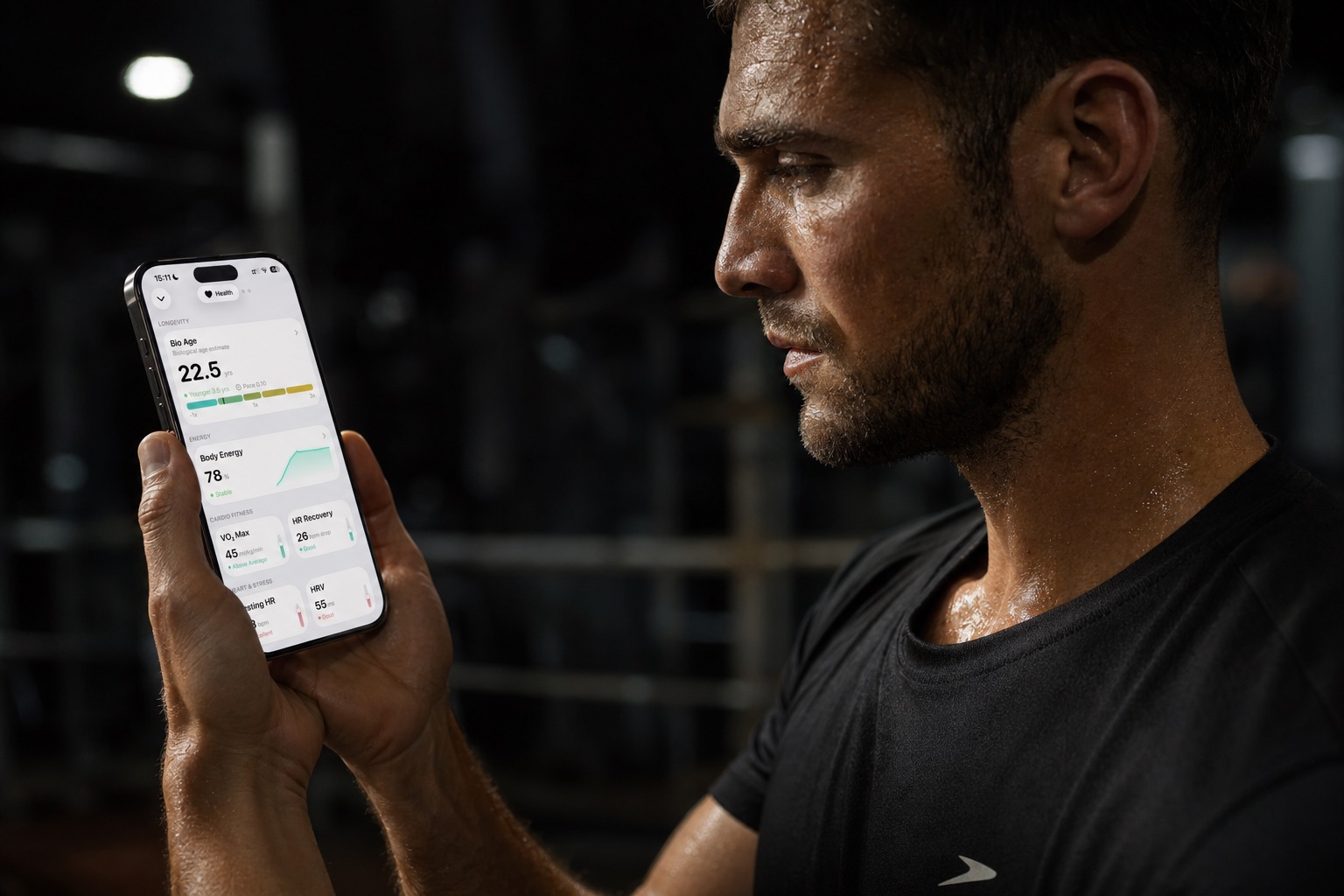
Most people know their resting heart rate. Some track their max heart rate. Very few pay attention to the metric that arguably tells you more about your body's readiness than either: heart rate variability, or HRV.
Professional sports teams have used HRV monitoring for decades. UFC fighters, NBA players, Tour de France cyclists, and Olympic athletes all rely on HRV data to decide when to push and when to pull back. In the last few years, consumer wearables have made this metric accessible to everyone. But accessibility doesn't equal understanding.
HRV is one of the most powerful and most misunderstood metrics in fitness. This guide will fix that. If you wear an Apple Watch, our Apple Watch recovery tracking piece connects these ideas to the metrics you already see in the Health app.
HRV Explained Simply
Your heart doesn't beat like a metronome. Even at a perfectly steady resting heart rate of 60 beats per minute, the time between individual beats varies. One gap might be 0.98 seconds. The next might be 1.04 seconds. The next might be 0.96 seconds.
Heart rate variability is a measure of these fluctuations — the variation in time intervals between consecutive heartbeats.
Counterintuitively, more variability is generally better. A heart that can fluidly adjust its rhythm in response to moment-to-moment demands is a well-regulated heart. A heart that beats with rigid, metronomic consistency is a heart under stress. Consumer wearables simplify a complex signal; for context from a clinical publication, see this Harvard Health overview of heart rate variability and wellness tracking.
Think of it like a car's suspension. A car with good suspension absorbs bumps fluidly. A car with shot suspension transmits every jolt rigidly. HRV reflects how well your body absorbs and responds to the bumps of life — physical, mental, and emotional.
The Autonomic Nervous System Connection
To understand HRV, you need to understand the autonomic nervous system (ANS). The ANS controls involuntary functions like heart rate, digestion, and respiratory rate. It has two branches:
Sympathetic Nervous System (SNS)
The "fight or flight" system. It increases heart rate, diverts blood to muscles, releases adrenaline and cortisol, and prepares your body for action. When the SNS is dominant, your heartbeat becomes more regular (lower HRV) because your body is in a state of alertness.
Parasympathetic Nervous System (PNS)
The "rest and digest" system. It decreases heart rate, promotes digestion, facilitates recovery, and generally puts your body into a restorative state. When the PNS is dominant, your heartbeat has more natural variation (higher HRV) because your body is relaxed and adaptive.
HRV is essentially a window into the balance between these two systems. High HRV suggests your parasympathetic system is active — you're recovered, adaptive, and ready for stress. Low HRV suggests your sympathetic system is dominant — you're stressed, fatigued, or still recovering from a previous stressor.
What's a "Good" HRV?
This is where most people go wrong. They see someone online posting an HRV of 120ms and panic because theirs is 45ms. But HRV is deeply individual.
Factors That Determine Your Baseline
- Age: HRV naturally declines with age. A 25-year-old's normal might be 60–80ms. A 55-year-old's normal might be 25–40ms.
- Fitness level: Aerobically fit individuals tend to have higher HRV baselines.
- Genetics: Some people naturally have higher or lower HRV independent of fitness.
- Sex: On average, males tend to have slightly higher HRV than females, though this varies.
- Body composition: Higher body fat percentage is associated with lower HRV.
The Only Number That Matters Is Yours
Comparing your HRV to someone else's is meaningless. What matters is your personal trend over time. Specifically, you want to know:
- Your baseline — the rolling average of your HRV over 30–60 days.
- Your daily reading relative to that baseline — is today's reading above, below, or within your normal range?
- The trend — is your baseline gradually increasing (getting fitter, recovering better), decreasing (accumulating stress, overtraining), or stable?
A reading significantly below your baseline (more than one standard deviation) on a given morning is a signal. A reading above baseline is a green light. Multiple below-baseline readings in a row is a louder signal.
How to Measure HRV
HRV can be measured several ways, but consistency is more important than method.
Wrist-Based Wearables (Apple Watch, Garmin, WHOOP, Fitbit)
Most modern smartwatches and fitness bands measure HRV using optical heart rate sensors (photoplethysmography, or PPG). The Apple Watch measures HRV during sleep and reports it in the Health app as SDNN (standard deviation of NN intervals).
Pros: Automatic, passive, requires no daily action. Measures during sleep when readings are most consistent.
Cons: Slightly less accurate than chest strap measurements. PPG can be affected by wrist position and skin tone.
Chest Strap + App (Polar H10, HRV4Training)
A chest strap with an ECG-style sensor paired with a dedicated app provides the most accurate single-point HRV readings.
Pros: Most accurate consumer method. Clinical-grade data.
Cons: Requires you to actively take a morning reading (1–3 minutes). Easy to forget. One missed reading creates a gap in your data.
The Morning Routine (For Manual Readings)
If you're using a chest strap or an app that requires a manual reading:
- Wake up naturally (or to your alarm).
- Don't get out of bed. Don't check your phone.
- Put on your chest strap and open your HRV app.
- Lie still in a comfortable position and breathe normally for 1–3 minutes while the app records.
- Log the reading.
Consistency is critical. Same time, same position, same pre-reading conditions. HRV is sensitive to almost everything — even one cup of coffee or a few minutes of scrolling social media can shift the reading.
Passive Overnight Measurement (Recommended)
For most people, passive overnight measurement via a wearable like Apple Watch is the best approach. It removes the morning ritual requirement and captures HRV during your most consistent physiological state (sleep). This produces the most reliable trend data with the least effort.
If you use an Apple Watch, Nour automatically pulls your HRV data and factors it into your daily Recovery Index score — no manual logging, no morning routine, no extra apps. You sleep, the watch measures, and the data is already waiting for you when you check your recovery status.
How to Use HRV to Guide Training Decisions
HRV data is only useful if you act on it. Here's a practical decision framework.
Green Light: HRV at or Above Baseline
Your autonomic nervous system is balanced or parasympathetically dominant. You're recovered and ready for stress.
Training decision: Go hard. This is the day for heavy lifts, high-intensity intervals, or that challenging workout you've been putting off. Your body can handle it.
Yellow Light: HRV Slightly Below Baseline
Your body is mildly stressed or still recovering. Not alarming, but worth noting.
Training decision: Train at moderate intensity. Stick to your program but consider reducing volume slightly. Avoid pushing to absolute failure. Focus on technique and quality over intensity.
Red Light: HRV Significantly Below Baseline (or Trending Down)
Your autonomic nervous system is sympathetically dominant. You're under-recovered, overly stressed, or getting sick.
Training decision: Active recovery or rest. Light movement, mobility work, a walk. Do not push through a red-light reading — the training stimulus won't produce adaptation when your body is in this state. You'll just dig a deeper recovery hole.
The Trend Matters More Than Any Single Day
One low reading can happen for dozens of reasons — a glass of wine, a late meal, a stressful email before bed. Don't panic over a single day.
What demands attention is the trend. Three or more consecutive below-baseline readings, or a gradually declining baseline over several weeks, signals that your recovery isn't keeping up with your stress load. That's when program adjustments are needed: reduced volume, a deload week, or addressing the non-training stressors (sleep, nutrition, work stress) that are dragging your HRV down.
HRV Trend: 2-Week Sample
Readings color-coded by readiness zone relative to baseline (51ms)
HRV Traffic Light Framework
Things That Improve HRV
If your HRV baseline is lower than you'd like, these interventions have research support:
Aerobic Fitness
Consistent cardiovascular training is the most reliable way to improve HRV long-term. Even 2–3 sessions per week of 30-minute moderate-intensity cardio (Zone 2 heart rate) can significantly increase parasympathetic tone over 8–12 weeks.
Sleep Quality and Consistency
HRV is exquisitely sensitive to sleep. Going to bed and waking up at consistent times, sleeping in a cool, dark room, and getting 7–9 hours per night are non-negotiables for healthy HRV.
Nutrition
Adequate hydration, balanced macronutrients, and avoiding large meals within 2–3 hours of bedtime all positively influence overnight HRV. Chronic caloric restriction and nutrient deficiencies suppress HRV.
Stress Management
Chronic psychological stress hammers HRV. Meditation, deep breathing exercises, time in nature, and social connection all improve parasympathetic tone. Even 5–10 minutes of deliberate slow breathing (inhale for 4 seconds, exhale for 6 seconds) can acutely improve HRV.
Cold Exposure
Brief cold exposure (cold showers, cold water immersion) has been shown to acutely stimulate the vagus nerve and improve parasympathetic activity. The research is still evolving, but many athletes report improved HRV with regular cold exposure.
Things That Worsen HRV
Alcohol
Even moderate alcohol consumption (1–2 drinks) significantly suppresses HRV for 24–48 hours. If you're serious about using HRV for training decisions, alcohol will consistently undermine the data and your recovery.
Poor Sleep
Late bedtimes, inconsistent schedules, sleep deprivation, and screen exposure before bed all reduce HRV. This is the single biggest modifiable factor for most people.
Overtraining
Excessive training volume without adequate recovery drives chronic sympathetic dominance, which shows up as persistently low HRV. This is one of HRV's most valuable applications — catching overtraining before it becomes a serious problem.
Illness
Even subclinical illness (before symptoms fully appear) can suppress HRV. Some athletes report seeing HRV drops 1–2 days before cold symptoms emerge. If your HRV tanks for no obvious reason, consider that your immune system may be fighting something off.
Chronic Stress
Work deadlines, relationship problems, financial stress, and other life pressures all suppress HRV. The autonomic nervous system doesn't distinguish between "I'm stressed about a deadlift PR" and "I'm stressed about my mortgage." It's all stress.
Late-Night Eating
Eating a large meal close to bedtime diverts blood flow to digestion during sleep, which reduces parasympathetic activity and suppresses overnight HRV. Try to finish your last meal 2–3 hours before bed.
HRV and Long-Term Progress
Over months and years of consistent training and healthy habits, you should see your HRV baseline gradually trend upward (or at least remain stable as you age). This upward trend reflects:
- Improved cardiovascular fitness
- Better autonomic nervous system regulation
- Enhanced recovery capacity
- Greater stress resilience
If your HRV baseline is declining over months despite consistent training, something in your lifestyle needs attention — typically sleep, nutrition, or life stress.
The Practical Takeaway
HRV isn't magic, and it's not a perfect measure of readiness. But when used correctly — tracked consistently, evaluated as a trend rather than individual data points, and combined with other recovery metrics — it's one of the most valuable tools available for making smarter training decisions.
You don't need to obsess over it. You need to check it, note the trend, and adjust accordingly. Push hard on green-light days. Moderate on yellow. Rest on red. Over months, this simple practice will result in more productive training days, fewer injuries, and faster progress than blindly following a fixed program regardless of how your body feels.
Nour pulls your HRV from Apple Watch and combines it with sleep, resting heart rate, and training load into one daily Recovery Index — so you always know whether to push hard or pull back.
Try Nour Free